Most of the decisions that go into a custom printed tube are visible: the diameter, the height, the artwork wrapping the body. The closure is the part buyers tend to leave until last, and it is the one that quietly decides whether the product inside stays fresh, whether the customer can open and reclose it by hand, whether it clears food-contact rules, and how the package feels in the first three seconds of use. Two tubes that look identical on a shelf can behave completely differently depending on what caps the ends. This guide walks through the closure options for custom paper tubes, what each one is good at, and how to specify the right one without over-engineering the part.
What a tube closure actually has to do
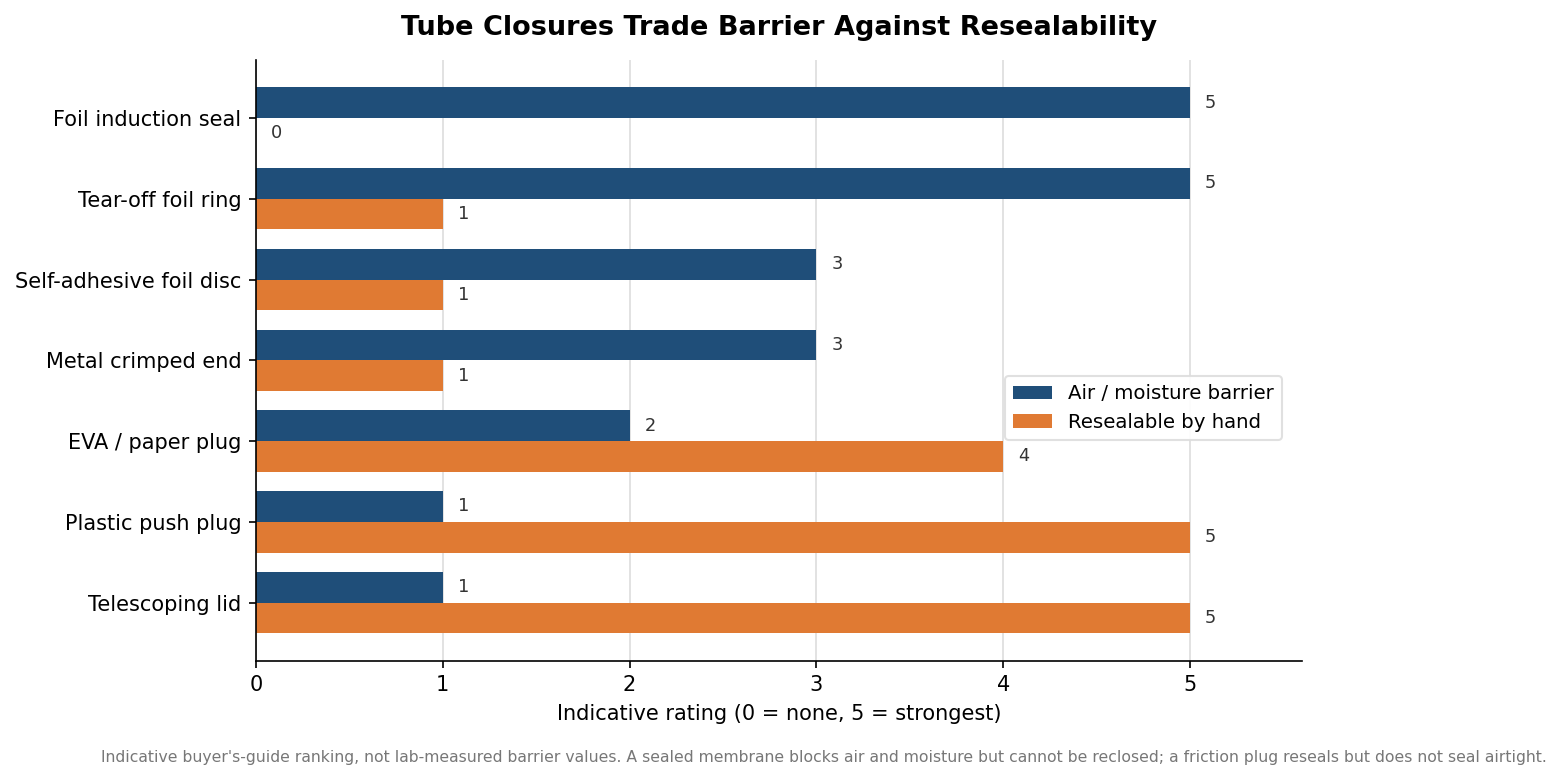
A closure is asked to do two jobs that often pull in opposite directions. The first is retention: holding the contents in and keeping the ends of the tube round and protected. The second is barrier: keeping air, moisture, and light away from the product. A friction-fit plug does the first job well and the second job barely at all. A sealed foil membrane does the second job extremely well but cannot be reclosed once it is opened. Almost every closure on the market sits somewhere along that trade-off, and the right choice starts with deciding which job matters more for your product.
For a candle, a set of dice, or a rolled poster, retention is nearly everything and barrier is close to irrelevant, so a simple cap or plug is plenty. For coffee, tea, protein powder, or a supplement, the barrier is the whole point, and a plug that lets air seep in over a few weeks will let the product stale before it sells through. The chart below shows the trade-off in rough terms; treat it as a way to see the pattern rather than as measured performance data.
Plugs and end caps: plastic, metal, paper, foam, and natural materials
Plastic push plugs are the default on one-piece mailing and retail tubes. They friction-fit into the open end, come in stock white, black, and clear, and open and close by hand with no tools. Suppliers stock them to match common inner diameters from roughly one inch up to five inches, so the plug has to be specified against the tube’s inner diameter rather than its outer size. Their weakness is two-fold: they do not create an airtight seal, and standard plastic plugs are not food grade, so they should not sit in direct contact with anything edible.
Metal ends are crimped onto the tube and give a more finished, premium feel. They resist crushing better than a plastic plug, can be produced with a hang tab for peg display, and are the usual recommendation when the closure needs to touch food. Paper plugs are the recyclable, single-material alternative: they keep the package to one waste stream and are also acceptable for many food-contact uses. EVA foam plugs trade some tidiness for cushioning, which makes them a sensible pick for fragile cosmetics, glass droppers, or candles that need to be held snug. At the premium end, cork stoppers and turned wooden caps are chosen mostly for how they look and feel, and they show up on spirits, gourmet food, and gift packaging where the unboxing moment justifies the added cost.
Sealed closures when freshness matters
When the product is sensitive to air or moisture, a plug alone is not enough and the tube needs a membrane. The simplest is a self-adhesive foil disc pressed onto the tube mouth; it suits dry goods like nuts and dried fruit but can lose its grip against moisture over time. An induction heat seal bonds a foil layer to the rim electromagnetically and produces a genuinely airtight barrier against air, moisture, and contaminants, which is why it is common on coffee and other moisture-sensitive foods. A tear-off foil ring is crimped to the edge with an integrated pull membrane, combining that airtight barrier with a visible tamper-evident feature. A shrink band adds tamper evidence too, but it is not airtight and should not be relied on to protect a moisture-sensitive product.
The practical pattern is that the strongest barriers are the least reclosable. An induction seal keeps coffee fresh precisely because it is permanent until the customer breaks it, so freshness-critical tubes are often built with a sealed membrane at the factory plus a reusable overcap the customer keeps for storage after opening.
Telescoping lids, push-ups, and how the tube body factors in
Not every closure is a plug. Telescoping designs use a separate lid that slides over the body: a two-piece tube with straight or rolled edges gives a clean lift-off lid, while a three-piece build adds a flush-fitting inner lip for a more deliberate, resistant open. These read as gift packaging and are popular for spirits, cosmetics sets, and premium candles. Push-up tubes borrow the deodorant mechanism to advance a solid product such as a balm or a solid perfume, and they typically carry a higher minimum because of the added tooling. The body itself also matters: wall thickness on custom paper tubes generally runs from about 0.75 mm to 2.5 mm, and a thicker, more rigid wall holds a crimped metal end or a telescoping lip more reliably than a thin one.
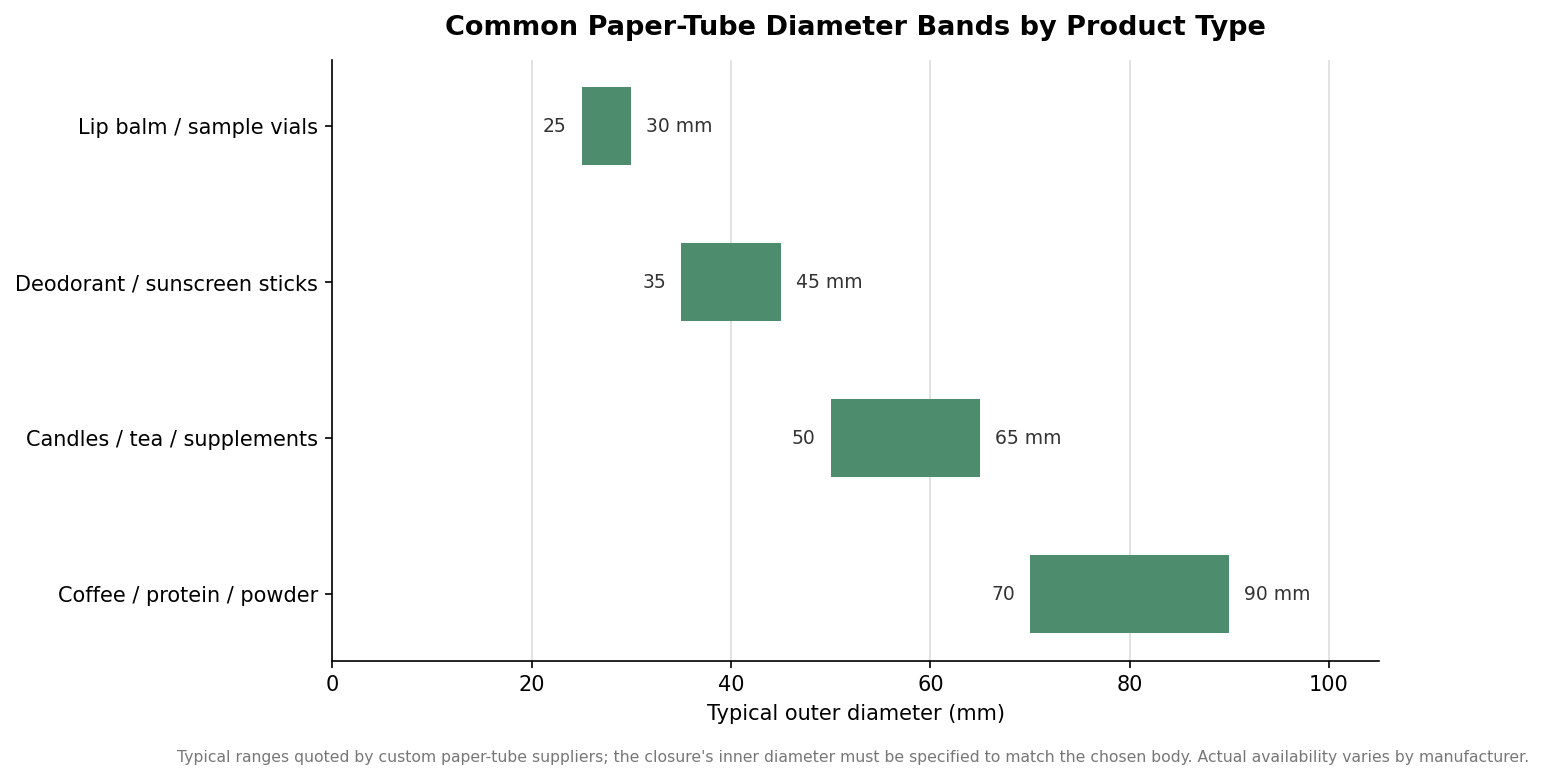
Because the closure has to match the body, diameter is where these decisions meet. The bands below show the outer diameters suppliers typically quote for common product types; the closure’s inner diameter is then specified to fit whichever body you choose.
Matching the closure to food rules, size, and lead time
Three constraints tend to decide the final call. The first is food contact: if the product is edible and touches the closure, skip the standard plastic plug and specify a metal end, a paper plug, or a food-grade membrane, and confirm any liner in the tube is rated for direct contact. The second is size and fit: a plug or lid is quoted against the tube’s inner diameter, so a body change of even a few millimeters can mean re-sourcing the closure, which is worth settling before artwork is finalized. The third is time and quantity. Custom tubes commonly start around a 1,000-piece minimum, with more involved features such as push-ups often closer to 2,500. Pre-production samples usually take on the order of two weeks, and mass production tends to run four to eight weeks depending on quantity and how much customization the closure adds. A sealed membrane or a custom-molded plug lengthens that timeline more than a stock plug does. These figures are indicative and vary by supplier, so treat them as planning ranges rather than promises.
The cleanest way to specify a closure is to hand the supplier four things: what the product is and its fill weight, whether the customer needs to reseal it after opening, whether it has to block air or moisture, and the budget and volume you are working to. From those answers a good manufacturer can point you to a plug, a membrane, or a telescoping lid quickly, and then the right move is always to buy or request a physical sample and open it yourself before committing to a full run. A closure is one of the few packaging choices you can fully judge only by holding it.